 Client Login
 Share on facebook
 Share on X

BlogEnglish
October 29, 2026Value Added Tax on Cross-Border Digital Sales in Indonesia
Selling digital products or services to customers in Indonesia can create tax questions for businesses based overseas.


When expanding into Indonesia, foreign investors may encounter the term limited liability company (LLC) while researching how to establish a local business.
However, an LLC in the United States does not have exactly the same legal structure as a company in Indonesia.
Understanding the differences matters when choosing an entity, assessing liability, planning ownership, and preparing to operate in Indonesia.
This guide explains how limited liability companies work, how they compare with Indonesian companies, and what foreign investors should consider before choosing a business structure.
A limited liability company (LLC) is a business entity that exists separately from its owners. It can hold assets, enter into contracts, and incur debts in its own name, while generally protecting owners from personal liability for company obligations beyond their investment.
This protection is not absolute. Personal guarantees, fraud, or other circumstances recognised by applicable law may expose owners to personal liability.
The term LLC is commonly used in the United States, while Indonesia recognises the Perseroan Terbatas (PT) as a company structure with a similar limited liability principle.
Under Article 3 of Law No. 40 of 2007 on Limited Liability Companies, shareholders are generally not personally liable for company obligations, subject to statutory exceptions.
Although both structures share this principle, their legal requirements and governance differ. Foreign investors should therefore assess the company structure recognised in the jurisdiction where they intend to operate.
Read Also: Guide to PT Penanaman Modal Asing (Foreign Company) in Indonesia
The exact rules depend on the jurisdiction and the type of company. However, limited liability companies generally operate through several core principles.
The owners of a company hold an ownership interest in the business. Depending on the jurisdiction, this interest may take the form of shares or membership interests.
Ownership determines the rights attached to the investment, which may include voting rights, participation in profits, and influence over company decisions. The specific rights depend on the company’s governing documents and applicable law.
A company can generally enter into contracts, own property, employ people, and conduct business independently of its owners.
This separation helps distinguish company obligations from the personal obligations of shareholders or members. It also allows the business to continue operating when ownership changes, subject to applicable legal requirements.
Company management varies across jurisdictions. Some LLCs allow owners to manage the business directly, while others appoint managers to handle operations.
Indonesian limited liability companies follow a different governance structure, with directors responsible for management and commissioners performing supervisory functions.
Foreign investors should review the governance requirements of the jurisdiction where they plan to establish their business.
The terms LLC, PT, Ltd, Pte. Ltd., and Sdn. Bhd. refer to company structures or designations used in different jurisdictions. Although they generally share the principle of limited liability, their legal requirements, ownership structures, and governance rules differ.
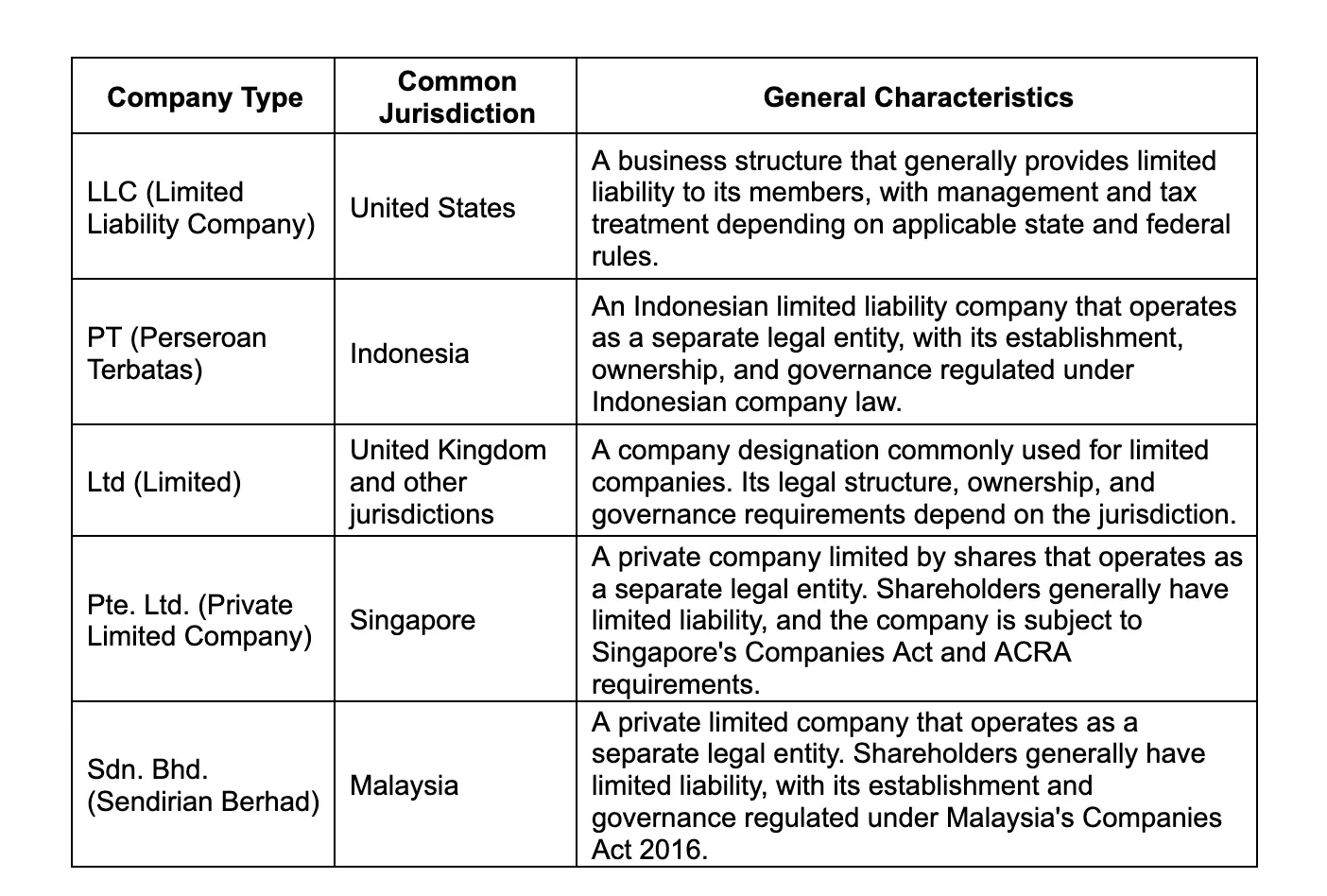
Although these company types share the principle of limited liability, they are governed by different legal systems. A company structure established in one country does not automatically provide the same rights, obligations, or operating flexibility in another.
An Indonesian Perseroan Terbatas (PT) is generally the closest local company form to a limited liability company in the broad sense. However, it is not legally identical to a US LLC.
Both structures generally separate the company’s obligations from those of its owners. Their governance, ownership arrangements, and regulatory requirements differ.
A PT is governed by Indonesian company law, including Law No. 40 of 2007 on Limited Liability Companies, as amended.
The company has a formal governance structure involving shareholders, directors, and commissioners. Its establishment and corporate actions must follow Indonesian legal and administrative requirements.
An LLC in the United States is established under the laws of the relevant state. Its operating agreement, management arrangement, and tax treatment depend on the applicable rules.
The structure may provide flexibility in how owners manage the business, but these features cannot automatically be applied to an Indonesian PT.
A foreign investor planning to operate in Indonesia needs to consider the local company structure, business activities, ownership restrictions, and licensing requirements.
The appropriate entity depends on the intended operation. A PT may be suitable for conducting business locally, while a foreign investment company, representative office, or another arrangement may be relevant in different circumstances.
Foreign investors can establish a company in Indonesia, but the available structure and requirements depend on the proposed business activities and applicable investment rules.
A foreign-owned Indonesian company is generally established as a PT PMA, or foreign investment company, where the activity and ownership arrangement are permitted.
Indonesia regulates foreign investment according to business sector and activity.
Some activities allow foreign ownership, while others impose ownership limits, specific conditions, or restrictions. The applicable requirements should be checked against the relevant business classification and investment regulations.
Investors should confirm the intended activities and applicable KBLI classifications before finalising the ownership structure.
A PT PMA generally requires at least two shareholders. Shareholders may be individuals, legal entities, or a combination of both, subject to applicable requirements.
The proposed ownership structure should be reviewed before incorporation to ensure it reflects the investor’s commercial objectives and the relevant legal restrictions.
Foreign investors should distinguish between paid-up capital and minimum investment value.
Under BKPM Regulation No. 5 of 2025, the general minimum paid-up capital for a PT PMA is IDR 2.5 billion, unless another applicable rule provides otherwise.
Separately, the general minimum investment value is more than IDR 10 billion, excluding land and buildings, for each five-digit KBLI business classification and project location. Certain sectors may follow different calculation rules or exceptions.
These figures serve different purposes and should not be treated as interchangeable. Investors should verify the applicable requirements for their specific business activity and structure before committing funds.
Establishing a legal entity does not automatically mean that every planned business activity can begin.
Depending on the activity, the company may need to obtain a Business Identification Number (NIB), fulfil risk-based licensing requirements through the Online Single Submission (OSS) system, and secure additional approvals or licences.
The requirements depend on the company’s business activities, location, and risk classification.
Choosing a company structure affects ownership, management, investment, and future operations. Before establishing a business in Indonesia, foreign investors should evaluate the following factors.
The business activities determine which legal and licensing requirements may apply.
For example, a consulting company and a business operating in a regulated industry may face different foreign ownership restrictions and licensing obligations. Confirming the appropriate KBLI classifications early can help prevent structural changes later.
Investors should decide who will own the company, how ownership will be divided, and who will manage its operations.
The structure should reflect the intended commercial relationship between shareholders while complying with Indonesian ownership rules and governance requirements.
Capital planning should account for the company’s applicable paid-up capital requirements and investment commitments.
Investors should also consider operational expenses, staffing, office arrangements, equipment, and working capital. These costs are separate from the statutory capital and investment thresholds.
Company formation creates ongoing administrative responsibilities.
Depending on the business, these may include tax registration and reporting, accounting, corporate administration, employment obligations, and investment reporting. Investors should assess these requirements as part of their operating plan.
The right structure should support the company’s expected activities in Indonesia.
Consider whether the business will hire local employees, employ foreign personnel, enter into local contracts, open additional locations, or expand into other business activities. These decisions may affect licensing, governance, and operational requirements.
Read Also: When to Transition From Employer of Record to PT PMA
Choosing a company structure is an important step towards entering the Indonesian market. The right decision depends on what your business will do, how you plan to structure ownership, and what you need to operate legally in Indonesia.
A PT PMA may be suitable if you plan to establish a foreign-owned business in Indonesia, but its requirements depend on your intended activities and investment plans.
Understanding these factors before proceeding can help you determine which structure fits your business objectives.
CPT Corporate helps you assess your company registration options, prepare incorporation documents, and navigate the relevant registration and licensing requirements in Indonesia.
Planning to set up your business in Indonesia? Explore CPT Corporate’s company registration Indonesia services and contact CPT Corporate to discuss your business objectives and understand the company structure and registration requirements relevant to your plans!
Table of Contents
Related Posts
Value Added Tax on Cross-Border Digital Sales in Indonesia
Selling digital products or services to customers in Indonesia can create tax questions for businesses based overseas.

Understanding ITAS in Indonesia: Visa Types, Stay Permit Rules and What Foreigners Need to Know
Foreign nationals planning to live in Indonesia for work, investment, family or another approved purpose need to understand which immigration permission applies to their circumstances.

Mandatory Export of Ferro Alloys Through PT DSI from 2027: What Is the Impact on Businesses?
Starting 1 January 2027, exports of ferro alloys can only be carried out through PT Danantara Sumberdaya Indonesia (PT DSI). Ahead of that deadline, the Ministry of Trade is evaluating whether the infrastructure, implementing regulations, and business actors are ready.

Schedule a Free Consultation!
Tell us about your plan and our consultants will reach out to you to assist with your needs.
