Hiring in Indonesia can become complicated when your business has found the right candidate but has not established a local entity.
You may be considering an EOR agency, a staffing agency, or a recruitment partner, but these services address different business needs.
Before choosing one, you need to understand who recruits the employee, who becomes the employer, and whether the proposed employment arrangement fits Indonesian regulations.
This guide helps you compare the options and identify what to verify before engaging an EOR agency in Indonesia.
Key Takeaways
- An EOR agency, staffing agency, and recruitment agency serve different purposes, so identify whether you need employment administration, candidate sourcing, or temporary staffing.
- An EOR arrangement generally involves the EOR becoming the formal employer while the client directs the employee’s day-to-day work, subject to the agreed scope and applicable law.
- Indonesia’s outsourcing rules changed in 2026, making it important to assess whether the role and arrangement are legally suitable before signing an EOR agreement.
- Compare EOR agencies based on their Indonesian employment structure, regulatory understanding, service scope, fees, and employee support rather than brand recognition alone.
EOR Agency vs Staffing Agency: What Is the Difference?
An EOR agency and a staffing agency may both help businesses engage workers, but their roles differ.
The key distinction is whether you need a company to employ a person you have selected, source candidates, or provide workers for a particular assignment.
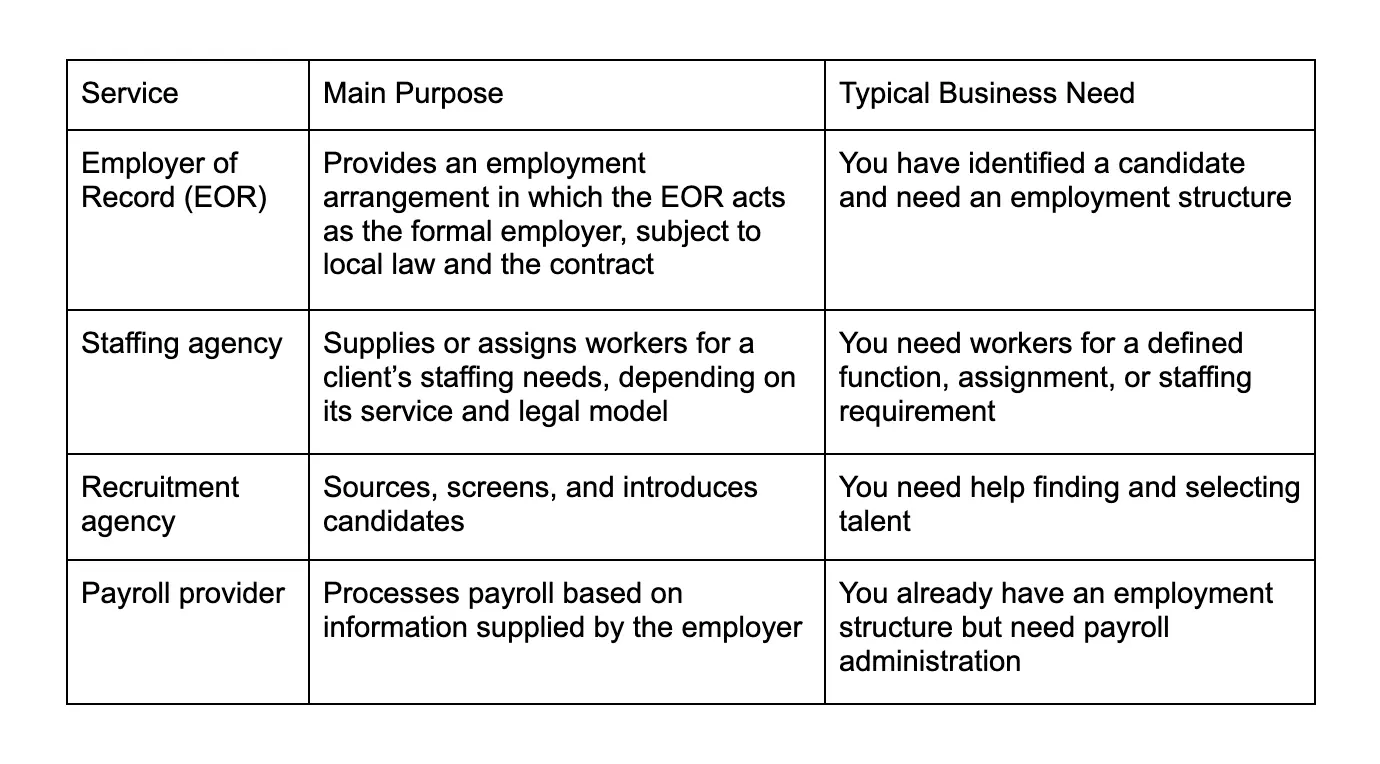
These terms are used differently across countries and providers. A staffing agency may offer recruitment, employment, or workforce management services, while a recruitment agency may simply introduce candidates for direct employment. Always review the actual service and contract instead of relying on the label.
Who Finds and Selects the Employee?
If your HR team has already interviewed a candidate and decided to hire them, you may not need recruitment services. Your immediate question is how to establish and manage the employment relationship in Indonesia.
An EOR arrangement may address that need, subject to the role being legally suitable and the provider’s agreed scope.
By contrast, a recruitment agency focuses on sourcing and screening candidates. Some staffing agencies offer both recruitment and employment services, so confirm what the agency will actually do.
Who Becomes the Formal Employer?
Under a typical EOR arrangement, the EOR company enters into the local employment relationship with the employee. The employee performs work for the client’s business, while the client usually directs day-to-day responsibilities, performance, and operational priorities.
This division needs to be clearly documented. The EOR agreement should identify the employing entity, the employee’s contractual relationship, each party’s responsibilities, and the limits of the client’s operational control.
The label “EOR” alone does not establish that an arrangement is permitted under Indonesian law. The nature of the work and the actual contractual structure matter.
Who Manages Employment Administration?
An EOR proposal may include employment contracts, payroll, salary payments, tax administration, social security administration, employee records, leave, and termination-related administration. However, the exact scope varies by provider and agreement.
A staffing agency may manage some of these functions if it employs or assigns workers. A recruitment agency usually focuses on candidate placement, while a payroll provider generally processes payroll without becoming the employer.
Ask for a responsibility matrix before signing. It should show which party handles each employment task, which information the client must provide, and who is responsible for decisions such as salary changes, performance management, or ending an engagement.
Read Also: Navigating the Recruitment Process in Indonesia for Your Business
Can You Use an EOR Agency for Hiring in Indonesia?
Yes, foreign companies can consider an EOR agency when hiring employees in Indonesia without establishing their own local entity.
Under this arrangement, the EOR employs the selected candidate through its Indonesian company and manages the agreed employment administration, while your business oversees the employee’s day-to-day work.
Before proceeding, confirm how the provider structures the employment relationship, which responsibilities it handles, and whether the arrangement suits your intended business activities.
If you plan to build a permanent local team, conduct ongoing commercial operations, or establish a broader business presence in Indonesia, a PT PMA may be a more suitable structure.
The right choice depends on your hiring needs, business activities, ownership plans, and long-term objectives. You can explore CPT Corporate’s company registration Indonesia services if you are considering establishing a local entity.
How to Evaluate the Best EOR Agency in Indonesia
Search results for “best EOR agency in Indonesia” often lead to provider lists and comparison articles. These can help you create a shortlist, but rankings alone do not establish whether a provider is suitable for your business or the role you want to hire.
Use the following criteria to evaluate each shortlisted agency.
1. Identify the Indonesian Employing Entity
Ask for the full legal name of the Indonesian company that will sign the employment contract. Confirm whether it is the EOR provider’s own entity or a local partner.
You should also understand which entity will be responsible for employment administration and how the arrangement is structured. A provider’s global brand may not be the entity employing your Indonesian staff.
2. Verify the Provider’s Local HR and Employment Expertise
An EOR agency should understand the practical requirements of managing employees in Indonesia.
Ask how the provider handles employment contracts, payroll administration, employee benefits, BPJS, and employment-related documentation under the applicable local requirements.
You should also assess whether its team can explain local employment practices and address employee matters when they arise. This helps you determine whether the provider can support your hiring needs beyond the initial onboarding process.
3. Review the Service Scope in Writing
Compare what each EOR agency actually includes. Your proposal should clarify whether the fee covers:
- Employment contract preparation and onboarding
- Payroll calculations and salary disbursement
- Employee tax administration
- BPJS-related administration, where applicable
- Leave, benefits, and employee records
- Salary changes and contract amendments
- Employee complaints and HR support
- Resignation or termination administration
Do not assume that every item is included in the monthly fee. Ask how the provider handles additional requests, corrections, or exceptional employee situations.
4. Understand the Full Cost
EOR pricing may be structured as a monthly fee per employee, a percentage of salary, or a customised quotation. The headline fee may not include every employment-related cost.
Request an itemised proposal that separates:
- EOR service fees
- Salary and statutory employment costs
- Benefits and allowances
- One-off onboarding or setup charges
- Additional administrative fees
- Termination-related costs, where applicable
- Taxes or third-party charges
Ask how the provider handles changes in salary, headcount, or employment terms. A clear cost model helps your finance team forecast expenses beyond the first invoice.
5. Evaluate Employee Support and Communication
The employee experience matters after onboarding. Your local team may need help with payslips, employment documents, benefits, leave, or questions about their contract.
Ask who employees contact for support, what languages are available, and how the provider handles urgent issues. You should also clarify how your HR team communicates employee changes and receives updates.
6. Check Contract Flexibility and Exit Arrangements
Your hiring needs may change after entering Indonesia. Review how the EOR agreement handles contract amendments, employee transfers, termination, notice periods, and switching providers.
Ask what happens to employment records and outstanding obligations if you end the arrangement. If you expect to establish a PT PMA later, discuss whether the provider can support a transition and which steps would require separate legal or employment advice.
Read Also: Employer of Record in Indonesia as a Market Entry Strategy
Is an EOR Agency a Long-Term Hiring Solution?
An EOR arrangement may be considered for a particular hiring need, but your long-term plans should guide the decision.
If you are evaluating Indonesia with a small team, the immediate priority may be understanding whether a suitable employment structure is available for the role. If you plan to build a larger local operation, establish commercial relationships, or employ people across core business functions, you may need to assess a local entity and its ongoing obligations.
Avoid treating EOR as an automatic first step towards incorporation. The transition depends on your intended activities, contracts, employee arrangements, licensing, and business plans.
CPT Corporate’s existing guide on transitioning from EOR to PT PMA can help you explore the structural considerations without repeating the full company-registration process here.
Discuss Your Indonesia Hiring Plans with CPT Corporate!
Choosing an EOR agency in Indonesia requires more than comparing monthly fees or international provider rankings.
You need to confirm who will employ your staff, whether the proposed role fits the current employment framework, and which responsibilities your business will retain.
CPT Corporate provides Employer of Record services in Indonesia, including employment arrangements through its Indonesian company and agreed employer-side administration.
The appropriate scope depends on your hiring requirements and the legal suitability of the proposed arrangement.
If you are planning to hire in Indonesia, contact CPT Corporate to discuss your intended roles, hiring structure, and next steps before proceeding!
 Client Login

 Share on facebook
 Share on X